A powder coat is only as good as the surface underneath it. Here is what happens to a part before the powder goes on, and why it decides how long the finish lasts.
A powder-coated part can look perfect on the day it leaves the plant and still start peeling or rusting under the paint within months. When that happens, the powder is rarely the cause. Usually the surface underneath was never properly prepared. Pre-treatment is the least visible step in powder coating, and it is the one that decides how long the finish lasts.
What goes wrong without it
- Oil and grease from cutting, bending and handling stop the powder bonding, which leads to poor adhesion and flaking.
- Rust, scale and oxide films trap corrosion under the coating. It spreads sideways from any chip or scratch, a problem known as underfilm corrosion.
- Dust and residues show through as bumps and craters in the cured film.
What multi-stage pre-treatment does
Industrial pre-treatment cleans the part and converts its surface in a sequence of chemical and rinse stages. A typical sequence includes degreasing, rinsing, rust or scale removal, rinsing, surface conditioning, a conversion coating such as phosphating, and final rinses. The conversion layer bonds to the metal and gives the powder a surface it can grip, which greatly improves adhesion and corrosion resistance. Every rinse stage matters, because chemicals carried from one tank into the next weaken the result.
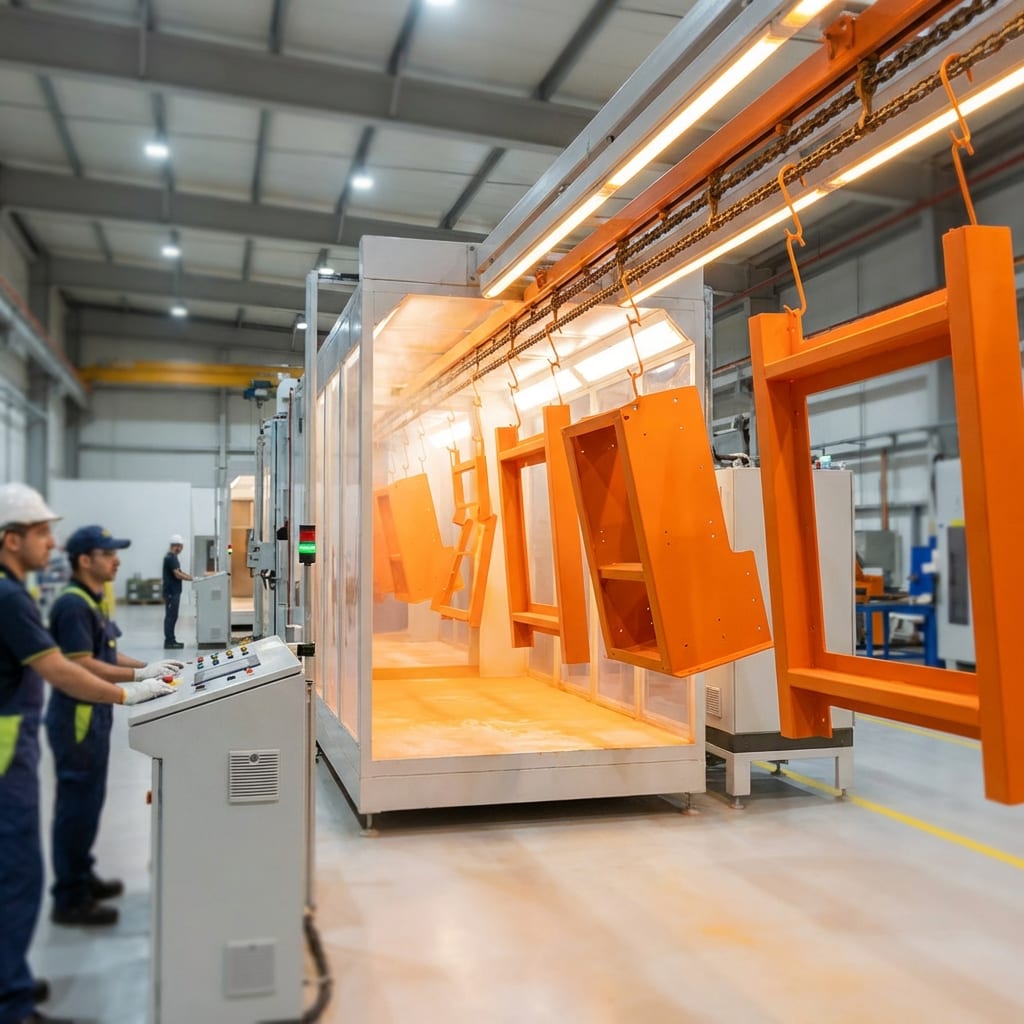
Our PLC-based plant uses a 9-tank pre-treatment process. Running more stages allows thorough cleaning and rinsing between chemical steps.
Dry before you coat
Moisture trapped in seams or on the surface causes blisters and pinholes when the part is cured. After pre-treatment, our parts are dried in an oven at 120 °C before they enter the booth.
Application and curing
The powder is sprayed electrostatically. We use a Wagner gun in a stainless steel booth, which can be cleaned quickly for colour changes. The part is then cured in an oven at the time and temperature the powder manufacturer specifies, so the powder flows out and cross-links into a hard, continuous film.
How the result is measured
The salt spray test (often run to ASTM B117) exposes coated samples to a continuous salt fog and records how long they last before corrosion or coating failure appears. It is an accelerated, comparative test. It does not convert directly into years of outdoor life, but it is a useful way to compare processes. Parts finished on our line sustain 900–1000 hours of salt spray testing.
What to tell your coater
- Colour (RAL or shade card reference) and finish: gloss, semi-gloss, matt or textured
- Indoor or outdoor use
- Surfaces, threads or holes that must stay uncoated (masking)
- Where the part can be hung, or whether a hanging hole can be added
- Quantity and any coating thickness requirement
Because cutting, bending, welding and coating happen in one shop, parts move straight from fabrication to pre-treatment, with no transport between suppliers and less handling damage.
All guides